James Thickett
Early Life Value
Summary
Early Life Value focused on improving the first critical weeks after signup — the period where customers either realise value quickly or disengage entirely. Working across e-commerce, marketing, product, and platform teams, this project addressed early attrition by clarifying the proposition, setting expectations, and guiding customers toward their first meaningful success moments.
My Role
I led the Early Life Value initiative as Lead UX Designer, owning problem definition, experience strategy, prioritisation, and stakeholder alignment.
UI design and visual execution were delivered in partnership with an external agency, which I directed day-to-day; shaping concepts, unblocking delivery, and ensuring solutions aligned to business KPIs and platform constraints.
The Problem
A significant proportion of new customers signed up for a fuel card but never made a single transaction.
Data showed that if a card wasn’t used within the first two weeks, the probability of future usage dropped close to zero.
While the proposition was compelling at the point of sale, the post-signup experience failed to reinforce value. Customers faced long delays before receiving cards, unclear next steps, unfocused onboarding communications, and a platform experience that felt empty and purposeless before any activity had occurred.
Through research, we also uncovered an overlooked persona:
Fleet managers who had inherited an existing fuel card provider rather than chosen it themselves; requiring the value of the product to be re-established from scratch.
Constraints
- Card manufacture, credit checks, and dispatch introduced unavoidable delays before first use, leading to a drop off in engagement
- Compliance requirements limited how intrusive digital marketing could be
- Multiple teams owned different parts of the journey (e-commerce, CRM/email, platform, mobile app)
- The platform was transaction-driven, offering little perceived value before activity began
- Multiple teams owned different parts of the early-life journey, with limited shared accountability
- Investment decisions required clear, measurable links to existing business KPIs
- Product development capacity was constrained, requiring phased delivery and prioritisation
- Some initiatives challenged established ways of working, requiring careful stakeholder alignment
Process
“Conversion was the starting line, not the finish.”
Personas:
- Primary: Newly onboarded fleet managers post-signup
- Discovered: Fleet managers inheriting an existing provider or account
UX Research:
- Funnel analysis revealed a sharp drop-off if no transaction occurred within two weeks
- Content audits showed onboarding emails were overly dense, unfocused, and largely ignored
- Platform analysis highlighted a “dead-end” experience for customers with no card activity
- Qualitative feedback exposed confusion around core benefits (e.g. discount diesel, where and how to use it)
“I think the app for finding fuel sites would be brilliant to give the people who use the cards.”
-Allstar Customer
“Drivers are always in a rush, to give them a different task like looking for different stations - could be too much. Can only enforce it if it is worth it.”
-Allstar Customer
Onboarding is a revenue lever.
Iterations & Exploration:
Mapped the full early-life journey across three domains:
E-commerce checkout completion
Early-life email communications
First-time platform experience
Defined a clear “first success” path rather than a feature dump
Designed cross-channel touchpoints to reinforce the same messages at the right moments
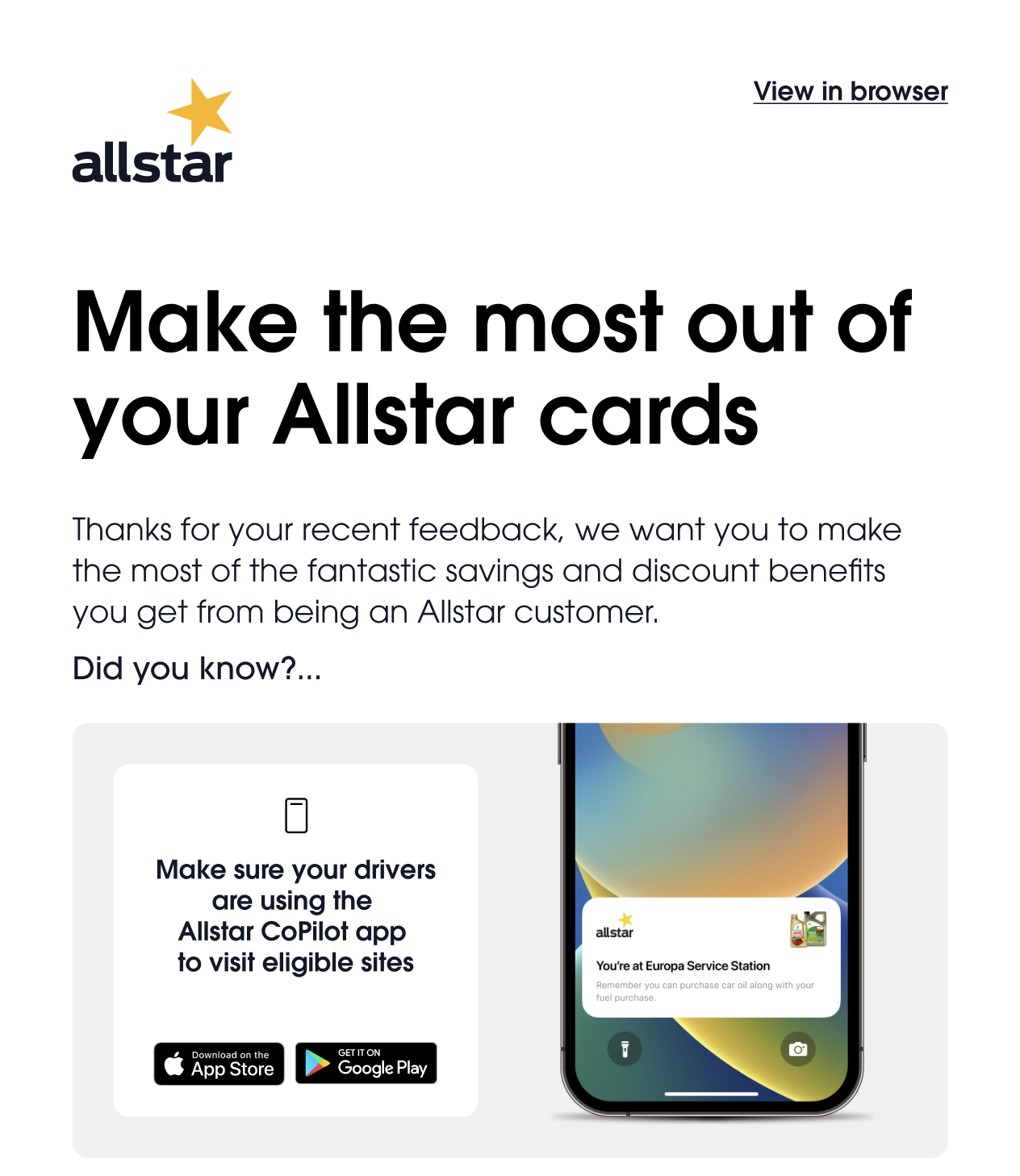
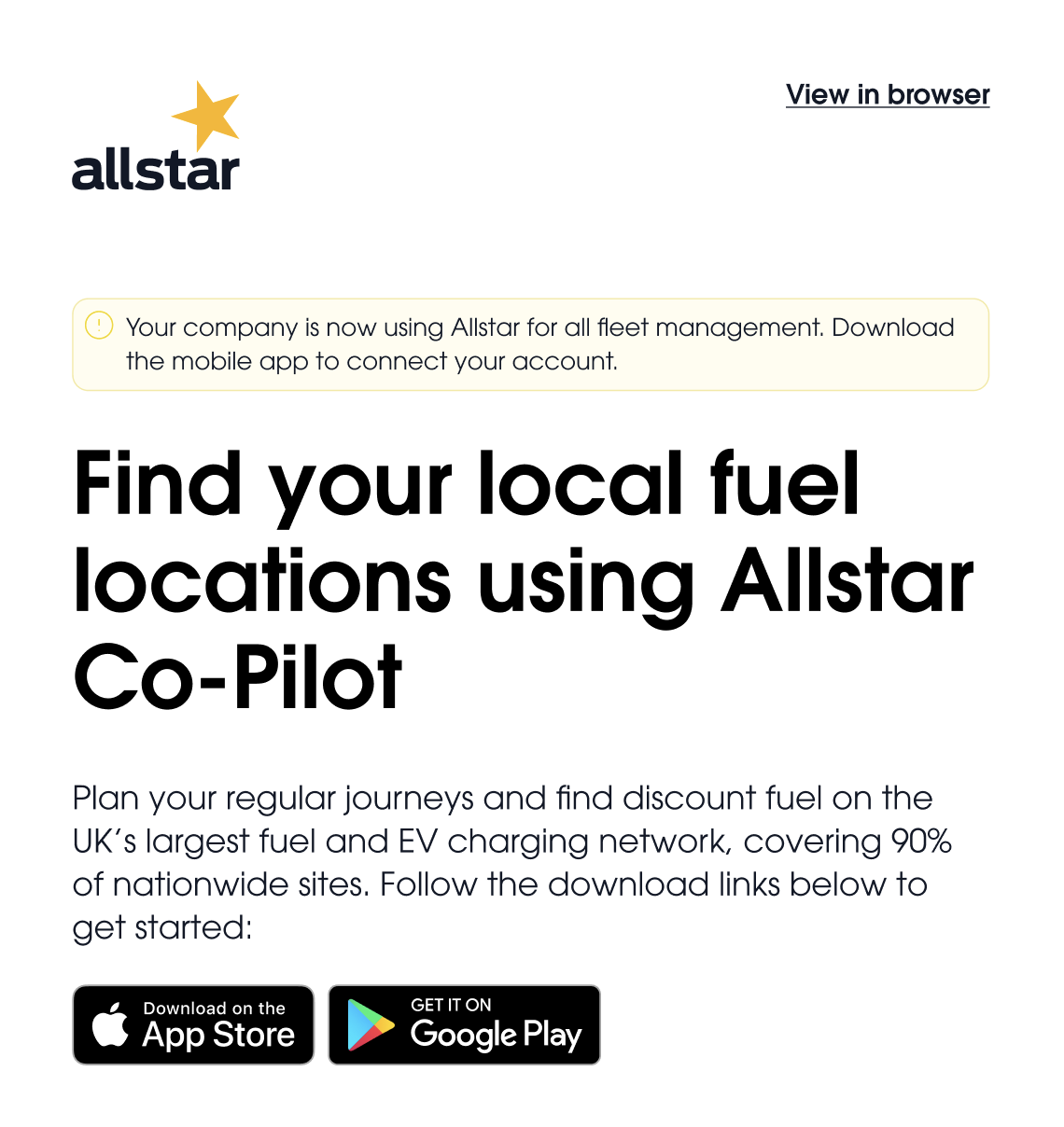
Examples of improved e-mail marketing with clear focus on app download
Solution
A guided early-life journey designed to move customers from signup to first value:
- Post-checkout experience - Replaced a blank confirmation state with clear next steps and expectation setting
- Reinforced key benefits customers could look forward to using
- Simplified onboarding communications
- Refocused early emails around a small number of clear actions
- Improved hierarchy, messaging clarity, and engagement cues
- Early-life platform experience
- Introduced a task-based “to-do” journey for new customers with no activity
Guided users through:
- Understanding how discount diesel works
- How and where to use it in practice
- Downloading and using the fuel site locator mobile app
- Discovering additional included benefits (AA cover, tolls, car washes)
- Connected platform UX, email comms, and mobile app usage into a single coherent journey
- Increased visibility of under-used but high-value tools already owned by the business
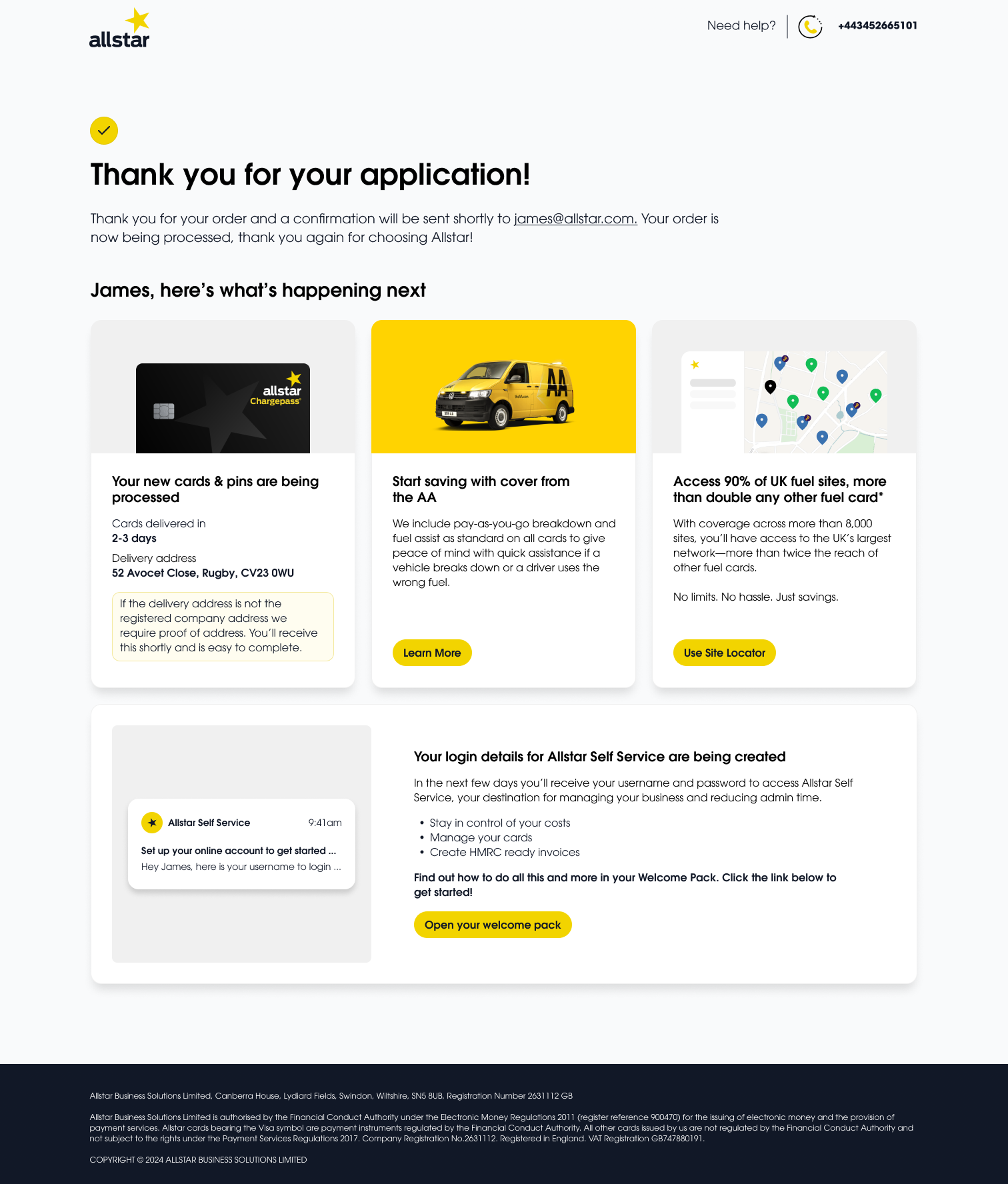
After applying: The thank you page was re-designed to show customers key proposition benefits, driving early engagement and also showed them tools they could start using now, such as our site locator and mobile app.
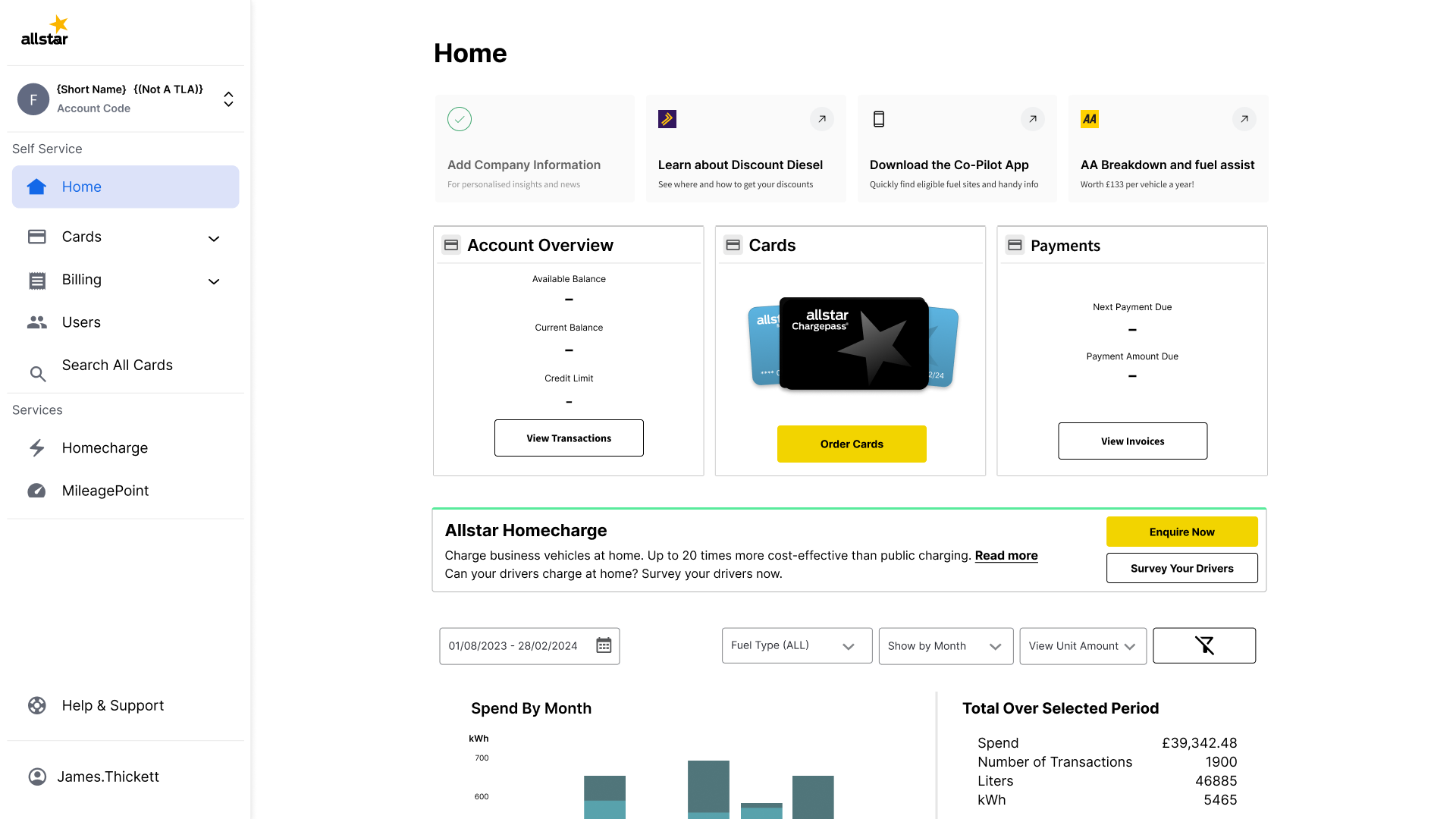
When customers first logged into the portal, they were presented with four core activities. Discount Diesel and Finding sites which have the discounts were the major drivers of friction and disengagement. By educating customers about how it worked and where to get it, and more importantly how their drivers could get it, we increase engagement and mobile app users.
Impact
- Reduced early-life friction and confusion during the highest-risk churn period
- Increased awareness and usage of core proposition features
- Improved perceived value before first transaction
Created a reusable ELV framework applicable to:
- New customer onboarding
- Role changes within existing accounts
- Future proposition launches
- (This work also directly informed later initiatives such as Digital Payments by highlighting the cost of delayed activation.)
2X
Increase in average duration spent on platform
Learnings
This project represented my first deep exposure to a genuinely multi-stakeholder environment, extending beyond product and delivery into commercial, CX, and revenue-focused teams.
While many of the problems were already well understood and documented within the business, this work required translating insight into practical, deliverable solutions that aligned with financial priorities and operational realities.
I learned the importance of pacing change, framing UX initiatives in terms of measurable business outcomes, and meeting stakeholders where they were, particularly when introducing solution-led thinking into traditionally analytical or reporting-focused teams.
Managing agency partners alongside internal teams further reinforced the value of clarity, prioritisation, and shared ownership. In hindsight, the project accelerated my ability to operate confidently across disciplines, balance ambition with pragmatism, and navigate complexity without losing sight of user outcomes.
This experience materially shaped how I now approach stakeholder engagement, delivery planning, and UX leadership in complex organisations.
Next: Reducing Contacts >
Early Life Value
Summary
Early Life Value focused on improving the first critical weeks after signup — the period where customers either realise value quickly or disengage entirely. Working across e-commerce, marketing, product, and platform teams, this project addressed early attrition by clarifying the proposition, setting expectations, and guiding customers toward their first meaningful success moments.
My Role
I led the Early Life Value initiative as Lead UX Designer, owning problem definition, experience strategy, prioritisation, and stakeholder alignment.
UI design and visual execution were delivered in partnership with an external agency, which I directed day-to-day; shaping concepts, unblocking delivery, and ensuring solutions aligned to business KPIs and platform constraints.
The Problem
A significant proportion of new customers signed up for a fuel card but never made a single transaction.
Data showed that if a card wasn’t used within the first two weeks, the probability of future usage dropped close to zero.
While the proposition was compelling at the point of sale, the post-signup experience failed to reinforce value. Customers faced long delays before receiving cards, unclear next steps, unfocused onboarding communications, and a platform experience that felt empty and purposeless before any activity had occurred.
Through research, we also uncovered an overlooked persona:
Fleet managers who had inherited an existing fuel card provider rather than chosen it themselves; requiring the value of the product to be re-established from scratch.
Constraints
- Card manufacture, credit checks, and dispatch introduced unavoidable delays before first use, leading to a drop off in engagement
- Compliance requirements limited how intrusive digital marketing could be
- Multiple teams owned different parts of the journey (e-commerce, CRM/email, platform, mobile app)
- The platform was transaction-driven, offering little perceived value before activity began
- Multiple teams owned different parts of the early-life journey, with limited shared accountability
- Investment decisions required clear, measurable links to existing business KPIs
- Product development capacity was constrained, requiring phased delivery and prioritisation
- Some initiatives challenged established ways of working, requiring careful stakeholder alignment
Process
“Conversion was the starting line, not the finish.”
Personas:
- Primary: Newly onboarded fleet managers post-signup
- Discovered: Fleet managers inheriting an existing provider or account
UX Research:
- Funnel analysis revealed a sharp drop-off if no transaction occurred within two weeks
- Content audits showed onboarding emails were overly dense, unfocused, and largely ignored
- Platform analysis highlighted a “dead-end” experience for customers with no card activity
- Qualitative feedback exposed confusion around core benefits (e.g. discount diesel, where and how to use it)
“I think the app for finding fuel sites would be brilliant to give the people who use the cards.”
-Allstar Customer
“Drivers are always in a rush, to give them a different task like looking for different stations - could be too much. Can only enforce it if it is worth it.”
-Allstar Customer
Onboarding is a revenue lever.
Iterations & Exploration:
Mapped the full early-life journey across three domains:
E-commerce checkout completion
Early-life email communications
First-time platform experience
Defined a clear “first success” path rather than a feature dump
Designed cross-channel touchpoints to reinforce the same messages at the right moments
Examples of improved e-mail marketing with clear focus on app download
Solution
A guided early-life journey designed to move customers from signup to first value:
- Post-checkout experience - Replaced a blank confirmation state with clear next steps and expectation setting
- Reinforced key benefits customers could look forward to using
- Simplified onboarding communications
- Refocused early emails around a small number of clear actions
- Improved hierarchy, messaging clarity, and engagement cues
- Early-life platform experience
- Introduced a task-based “to-do” journey for new customers with no activity
Guided users through:
- Understanding how discount diesel works
- How and where to use it in practice
- Downloading and using the fuel site locator mobile app
- Discovering additional included benefits (AA cover, tolls, car washes)
- Connected platform UX, email comms, and mobile app usage into a single coherent journey
- Increased visibility of under-used but high-value tools already owned by the business
After applying: The thank you page was re-designed to show customers key proposition benefits, driving early engagement and also showed them tools they could start using now, such as our site locator and mobile app.
When customers first logged into the portal, they were presented with four core activities. Discount Diesel and Finding sites which have the discounts were the major drivers of friction and disengagement. By educating customers about how it worked and where to get it, and more importantly how their drivers could get it, we increase engagement and mobile app users.
Impact
- Reduced early-life friction and confusion during the highest-risk churn period
- Increased awareness and usage of core proposition features
- Improved perceived value before first transaction
Created a reusable ELV framework applicable to:
- New customer onboarding
- Role changes within existing accounts
- Future proposition launches
- (This work also directly informed later initiatives such as Digital Payments by highlighting the cost of delayed activation.)
2X
Increase in average duration spent on platform
Learnings
This project represented my first deep exposure to a genuinely multi-stakeholder environment, extending beyond product and delivery into commercial, CX, and revenue-focused teams.
While many of the problems were already well understood and documented within the business, this work required translating insight into practical, deliverable solutions that aligned with financial priorities and operational realities.
I learned the importance of pacing change, framing UX initiatives in terms of measurable business outcomes, and meeting stakeholders where they were, particularly when introducing solution-led thinking into traditionally analytical or reporting-focused teams.
Managing agency partners alongside internal teams further reinforced the value of clarity, prioritisation, and shared ownership. In hindsight, the project accelerated my ability to operate confidently across disciplines, balance ambition with pragmatism, and navigate complexity without losing sight of user outcomes.
This experience materially shaped how I now approach stakeholder engagement, delivery planning, and UX leadership in complex organisations.
Next: Reducing Contacts >
